
Matthew Leardi
Artist Statement
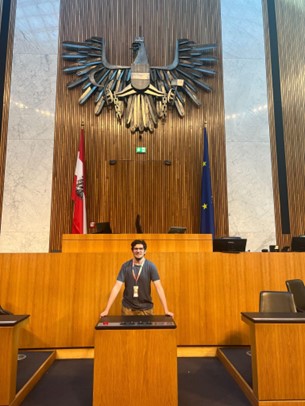
Excerpt of The Lawrenceville Anomaly
I was listening to my favorite podcast CreepCast, which consists of two YouTubers (Isaiah Nichols a.k.a Wendigoon, and Hunter Hancock a.k.a MeatCanyon) reading online short horror stories of varying quality. There were these two stories that broke my mind, not because they were scary or the themes were upsetting, but rather they overexplained events or ideas the reader understood a la 'exposition dumping'. So I wanted to write something making fun of it: The Lawrenceville Anomaly. It's still a work-in-progress.
There are a few things you'll notice when reading: footnotes, and typographic 'shenanigans'. Most of the time in academic settings, footnotes are primarily used for references or explanations, but in post-modern literature they can be used to expand the narrative. This is a device used in two novels that have influenced me, Mark Z. Danielewski's House of Leaves and David Foster Wallace's Infinite Jest.
My use of typography illustrates two things: proximity to the character Jeb, and corruption of the text. When the indescribable 'thing' is slowly approaching him, I illustrated this via incrementally increasing font size. To illustrate the idea of 'corruption' I utilized different fonts to make it appear as if the text is changing while the story progresses. An example of this is the use of 'Zalgo' text, a makeshift font which adds numerous diacritics onto a letter or word.
Heldenplatz
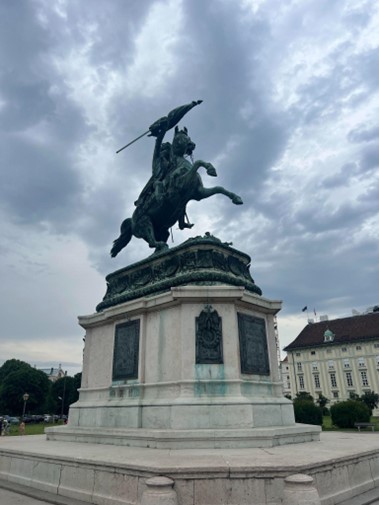
Heldenplatz is a public plaza in front of the Nationalbibliothek in Vienna, Austria. The library is famous for being the linguistic database of the multinational Habsburg-Empire, but it is infamous for being the location of the Anschluss rally, where tens of thousands of people stood to see Hitler's speech after Germany annexed Austria in March 1938. It is a juxtaposition that, while less present today than in the 1980s and 1990s, is still felt. In the picture I took sits a statue of the Austrian general Archduke Charles I which was unveiled in 1860, and surprisingly survived several bombings. In this poem I attempted to emphasize the perspective of the statue and its position in the public plaza. My goal was to show how this statue has stood in its place and watches the people who pass by, while contrasting it to when Vienna welcomed its new fascist government.
Vardo
The Romani are Europe's largest minority group known for their 'nomadic' lifestyle. They gradually migrated from northwest India and arrived in the Balkans some time in the mid-to-late 14th century. Since then they branched out throughout Europe, facing horrifically racist persecution, slavery, deportation, and being one of the larger populations killed in the Holocaust. Even today Roma people face persecution in Europe, being accused of theft, trafficking, and unwilling to assimilate.
While migrating between northwest India to Europe, the Roma people added new loan words and different cultural traditions from each place they migrated to like Armenian, Byzantine Greek, South Slavic, etc.. They migrated with their horse-drawn wagons called a 'vardo', which held their families and their personal possessions.
In this poem I tried to illustrate these facts with Małgorzata Mirga-Tas' diverse color range in the narrative of a group hoping to find a place that welcomes them.
The Lawrenceville Anomaly
Excerpt from Part III: Sea of Earthy-Concrete
Inspired by Little Gidding, MD. April 10th, 1921 (Toe Keen)1
Jeb stumbled into the small town in a euphoric, deafening confusion. The contradictory nature of his surroundings left his newly widower-life numb. The endless abyss of night sky began to illuminate something cloud-like in hints of green and tinges of purple2, while the avian monstrosity following him radiated a ghoulish carcosian yellow3. The town that Jeb knew his entire life, the one that raised him, the one he was just in only hours earlier, turned to a swamp of desecrated ruins. Time felt halted and speeding at the same time.
Looking back down to his horizon, Jeb's perspective was polluted by a mirage of surrealistic contradiction. The main street looked like it was solid, yet at the same time tangible objects were sinking into the pavement. Cars. Mailboxes. A telephone pole. Man konnte nur Bahnhof verstehen4 5. No one was in sight.
Huh.
The dead end of the street was no longer there. It jus̵̉͜t̸̼̾ ̵͚͠ĉ̴͈o̷̐͜ṋ̴̈t̵̞̚i̵̬̿n̶̹̈́u̷̧͐é̸͕ḏ̵͑
ĭ̸̜n̸͓̦͋f̷̡͚͛̃i̵͇̱͐n̴̦͝ḭ̷̖͗t̸̻̏̊e̴̗̒l̸̜͛y̶͈̳̌
Jeb had one of two choices to make. He could turn around, drive past his farm and go to another town and warn them, or he could walk forward and investigate. There was a problem with this dichotomy, which turned into a unichotomy.
He could hear the gurgling of sound.
S̶͇̓s̶̞̎s̷̩̏s̶̱̕ḻ̸͊s̴̬̾l̷̞͗l̸͎͝l̷̤̉s̴̡͋ḻ̸͒l̸̼͆l̵̞͂s̵̟̈́ḷ̴̉l̵̹̀l̸̗̽s̸̱̈́l̶͕̓i̸̘̔ş̵̿s̸͈͘s̵̻͆s̸͈̽s̶̨͠h̷̢͝h̴̞̀ḩ̷͐h̷͔̍h̸̭͊h̵͍̊h̷̺̕ȟ̵̬h̵͕̍ĥ̴͙h̵̝͌h̶̀͜h̴̻̓ SHhslhjluisshusghushskbhfjksyuobhjkabhussghuaabhjdkf
He could only guess based on the noise that it was massive. Unhuman. Primordial.
Abhjskbhjabhjksbbsbhkaj̴̭̔̔̌̐͗h̴̛̳͐̆̅̚͝è̸͇͓̣̪͉̅̒h̴̥̦̲̲̭̎͑͜͝͝ē̴͕̕̚ḣ̸͔̀̎̅̎̐ë̸̛̫̺͐̌͠͠h̶̭̃á̷̦̟͍͙̽ͅahsbhuschlchljipshhschshcsscbhsbhloscbhss
hsh
The confusion of the night's events and the broken laws of physical sciences couldn't justify Jeb's furthering himself into a reality no longer there. With no other option, Jeb moved forward to infinity street. Body fully submerged in the liquid concrete, mud, and grass. As long as he doesn't turn around towards the unknown abomination. He could go on for the rest of the night.
© 2026 Matthew Leardi
1 See https://atoekeneffort.weebly.com/. Commissioned. Ruffman, S. (2021). The Call of the Void. Blood Knife. https://bloodknife.com/call-of-the-void/
2 What has confused meteorologists and physicists from US Army Base Fort Riley and University of Kansas is that there was no record of an Aurora Borealis in the locality of the states of Kansas, Nebraska, Oklahoma, Missouri, North Dakota, or South Dakota. See the National Oceanic and Atmospheric Administration (NOAA) for further details on magnetical disturbances of the earth and its effects on human visual stimuli.
3 See “Husserlian Phenomenology of Colour-Theory and Cosmic Significance”, Castaigne, H. & Wilde (1920). The Imperial Dynasty of America. Publisher unknown. New York City, NY.
4 Colloquial Standardhochdeutsch for 'one couldn't understand', literal meaning being 'one could only train station understand'. See Langenscheidt Großwörterbuch Deutsch als Fremdsprache. Langenscheidt-Verlag. Berlin, Deutschland.
5 This is incorrect, as the saying is actually ich verstehe nur Bahnhof. It is not possible to add the modal verb können without altering the idiomatic meaning of the expression. Furthermore it should also be noted that it is unknown whether Jeb himself speaks or at the very least understands German, or if the author of this text is using this as a literary device. See Stokke, A. (2021). Free Indirect Discourse in Non-Fiction. Frontiers in Communication. (Psychology of Language).
6 Neologism based on English morphological derivation and blending, which takes 'dichotomy' ((etym. Greek) meaning 'division into two classes'), and replacing the 'di' prefix with the Latin prefix 'uni', meaning 'one'. As a result: 'unichotomy', or a division into just one class. See Tyler, A. & Nagy, W. (1987). The Acquisition of English Derivational Morphology. Center for the Study of Reading. University of Illinois.
Statue von Archduke Karl I, Heldenplatz, Wien, Österreich
I stand here. I’ve stood here for nearly 150 years.
As I’ve stood I've seen all who pass through my kingdom of concrete and brick.
I have seen you all at your best. I have seen you all at your worst.
Ich habe im Frühling 1938 hier gestanden, als die Stadt freiwillig ihre Seele verkauft
hat.
Ich habe hier gestanden, als tausende Personen hier gestanden haben, um ihren neuen
Führer zu begrüßen.
I stood here when the city saw the consequences of their choice.
I stood here when the city was cut into four.
I stood here when the city had to come to terms with their inhumanity.
I still stand here today as I did yesterday and the day before.
I will always stand here, and I will see the marks of those who come past me.
© 2026 Matthew Leardi
© 2026 Matthew Leardi. All rights reserved.
Statue von Archduke Karl I, Heldenplatz, Wien, Österreich
Vardo
Millions of miles, millions of people, but it ends—always ends—the same way
We kept our heads up despite being put down for crimes never committed
Everywhere we go we pick up a separate color with a forgotten meaning
And everywhere we flee we carry that color still to this day
Maybe another million miles to go before our vardo can lose its wheels and become
our home
© 2026 Matthew Leardi
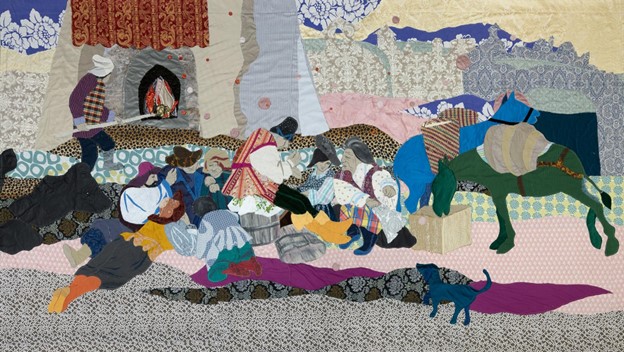
'Family Visit' by Malgorzata Mirga-Tas (2022). Currently housed at Kunsthal Charlottenborg,
Copenhagen, Denmark.
https://kunsthalcharlottenborg.dk/en/exhibitions/malgorzata-mirga-tas/