
Layla Handy
Artist Statement
Lucretia Artist Statement
This poem was the very first original poem I crafted for this project! The position and pose of Lucretia conveyed in the painting was very striking and intriguing to me because it inspired me to learn more about the story behind the painting. After learning about the history of the painting, I was really inspired to attempt to continue the story of Lucretia by using her voice to tell her story, instead of telling her story through the voice of another. In using her voice as the speaker, I saw this as giving her a voice in her own narrative, which directs the audience into seeing her point of view to understand her experiences that, unfortunately, led her to take her own life. In doing this, I wanted to provide the audience with an uncomfortable truth of our society, highlighting how many survivors of sexual assault, rape, and sexual violence often are neglected and shunned when coming forward, leading some to unfortunately engage in self-harm.
Mary Magdalene Artist Statement
This by far was the hardest poem to write for this project. Wanting to bring in my faith and create a compelling story that does not sound like my other poems in this collection was more challenging than I first intended. Despite the story at the center of the poem, I really wanted to incorporate more spiritual imagery often associated with the bible and the Christian faith which I think really shines through in this poem. Following the theme that was reflected in the previous poems, I really wanted to provide another lens and outlook into the issues of female agency and elevate the voices of women to tell their own stories and how this can be explored through the spiritual lens.
Sins of The Flower Artist Statement
This has been a long poem in the making. Redraft after redraft and rewrite after rewrite, this poem has been on my mind ever since my sophomore year of high school. This poem is not based on one sole incident, but rather an accumulation of experiences and stories entrusted to me from people I hold near and dear. And that is perhaps why it took me so long to craft this poem. Who was I, a young girl writing on this subject? And who am I now, a young woman, still trying to tell this story? And with that lies the very reason why this poem is so important. This poem tells not just one story. Instead, it functions as a voice – an insight – into the lives of many people who have experienced incidents such as rape, sexual assault, and sexual violence. In doing this, I wanted to provide the audience with an uncomfortable truth of our society, highlighting how many survivors of sexual assault, rape, and sexual violence often are neglected and shunned when coming forward. In writing this poem, I can only hope this poem can aid in the discussion.
Lucretia
Inspired by Artemisia Gentileschi’s Lucretia 1627 c.
Dagger in hand,
I rise to take my final stand,
For I have nothing left in this land —
The land for the darling dames,
With the sweetened names,
That stirs no flames,
And bears no shames,
Where I am the lone defamed.
Where no one will say my name.
Alas, it is no longer pretty —
No longer a melody —
No longer heavenly —
That has no remedy,
To return what was stolen from me.
My stolen honor,
.
A fallen daughter,
Leaving me in shame —
Leaving me to blame —
Without a pretty name,
Where he is just the same.
And so I take my leave,
Poor banished child of Eve,
An aid to my own demise,
Only for twilight's eyes.
O, dagger through my heart,
Please allow me to depart,
And don't stop until the deed is done,
Until I see heaven's sun,
Until I bleed scarlett red,
And lie cold and dead,
But know this body I leave,
Is no vessel to grieve,
Yet a testament to what was broken —
To what he has stolen.
And in my defame,
And in my shame,
You will finally say my name.
Lucretia.
© 2026 Layla Handy
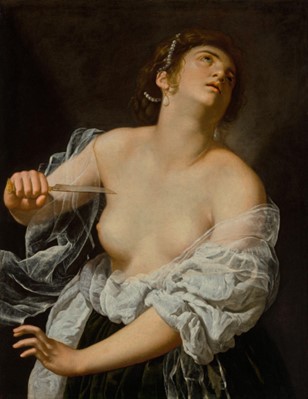
Artemisia Gentileschi, "Lucretia," about 1627, oil on canvas. The J. Paul Getty Museum, Los Angeles. Digital image courtesy of the Getty's Open Content Program.
Mary Magdalene
Inspired by Artemisia Gentileschi, St. Mary Magdalen, c. 1620, Pitti Palace, Florence
Lady of the evening,
To have while dreaming,
Of a girl much pleasing,
To hold so closely,
When the night falls lonely,
For she is but only,
A gentle time,
A sweetened rhyme,
At the cost of a dime,
For that's all they'll ever see —
All I'll ever be,
All for eternity,
As if it's not written,
I was the first to proclaim He has risen —
I was the first to see Him ascend,
When they thought it was the end,
And trusted me to tell the story,
Of His glory,
That they then relayed,
And replayed,
And remade,
Into books of the gospel,
With me as apostle to the apostles.
Who wanted shelter from the dark,
Like Matthew, like Luke, like Mark,
That no teacher,
Or preacher,
Could save,
From her sinful ways —
Turned away from heaven's gaze.
© 2026 Layla Handy
Sins of The Flower
Inspired by Yana Evans, Studies of Greens. Lotus (2024)
For my mother, Mary Marie, and so many more…
Sins of The Flower.
My darkest hour.
A story — my story,
Void of all honor,
Void of all glory.
Passed on through whispers,
From mothers to sisters,
To warn of what could be.
To warn of what became of me.
"Of she,
And she only,
Who sleeps,
Tangled in maroon sheets,
His hand across her shoulder,
See how he holds her,
Admits the twilight hour,
The tale known as 'The Sins of The Flower'."
And that's all they'll ever see,
All I'll ever be,
Never he,
Who opened my door,
Crossed the bedroom floor,
As I dreamed of pink balloons,
Floating through easy toons,
Ever so slowly,
Resting on my sheets of rosy,
As I dreamed of pink balloons,
Floating through easy toons,
Ever so gently,
Pushing aside Sergeant Teddy,
Who couldn't protect me,
From a weight too heavy,
To bore,
To endure,
When he tore —
And in my fairy room,
A castle just for little June,
Was I left to my own gloom,
Seeping and bleeding maroon.
© 2026 Layla Handy