
Jack Ward
Artist Statement
As a writer, I trend much more towards prose, and towards long-form fiction at that, so I was admittedly a bit out of my element in this project (but how else are we to grow, yes?). That said, I have been a great fan of poetry ever since I first started looking into Amy Lowell (check out Sword Blades and Poppy Seed for a brilliant forward on poetry as craft), and I find that a well-curated collection of poems can be a beautiful and efficient way to display a theme with emotion. My three works compiled herein are all about people being reduced to "subjects" in some way, as only things of beauty or casualties of war or what-have-you. As much as I love fiction, poetry, and art, I love people more and I find it a terrible shame to diminish them so. Now, it is not hard to tell that one of my works is not really a poem. Well, maybe it's a prose poem, but that's a rather blurry line. This is because I love prose, I am invested with the free will to write it, and nobody had it in them to tell me no.
Now that I'm done with my (mildly pretentious) statement, I really do hope you enjoy my work and the brilliant work of my colleagues!
Concerto in Red
Wide eyes.
It's her first time in this clean, pale dress.
But it feels wrong, doesn't it?
It flows well, she keeps still.
You can't just be natural
On the day of your immortalization.
The rug's not helping.
Red hair.
She's not from this room.
Nor from any room like it.
The painter invited her in.
Told her to stand very still.
And to be natural.
The curtain isn't helping either.
Composed.
The flower in her hand
Wilts downwards,
Picked from its spot.
Pale petals,
For her to display.
Lost in the white of the dress.
Rough edges.
A commentary on lines, he says.
An abstraction.
She's meant to be, at least.
But that red seeping out from under the rug?
That looks real enough for her.
© 2026 Jack Ward
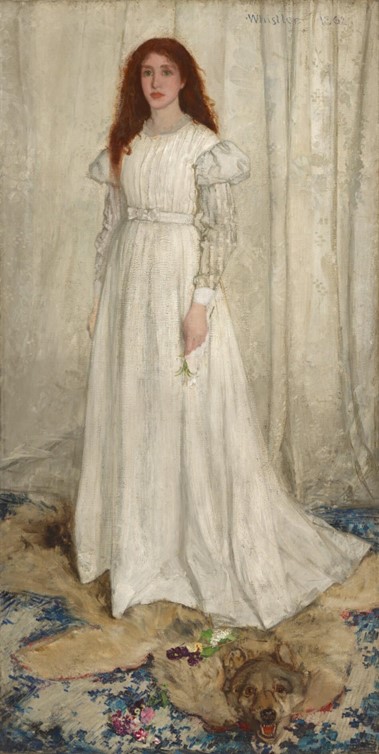
James McNeill Whistler, "Symphony in White No. 1: The White Girl", National Gallery of Art, Washington D.C.
Glory at Flores
Red painted across white sails.
Two nations at war.
Two nations under the same cross.
One hundred and ninety, that's the estimate,
For the men that crewed the brave galleon Revenge
Captained by the heroic Sir Richard Grenville.
(Known for such greats as stealing Irish land)
By the end of the day, there will be sixteen.
Clink the glass!
Lord Tennyson pours his absinthe and writes for the absence
Of a glorious upper class.
Who fought valiantly, no doubt,
And stood brave!
Fore Grenville never turned his back upon Don or devil!
While ninety men died of fever in view of fifty-three ships.
Look there! Bottom-left.
A peek into reality obfuscated by the smoke of cannon-shot.
Nothing glorious clinging to shattered mast.
Red coat suffused with rising blue.
It burns when water enters the lungs,
And that man drowned.
How's that for Revenge?
Dig two graves, bury one hundred and seventy-four.
The ship will sail.
For another few hours.
Grenville died on the deck of a Spanish ship.
He decided, in his endless bravery,
That ninety sick men would fare better on a sinking ship,
Outnumbered, outmanned, outfought,
Dying with their hundred comrades who could well have fled.
Than they would as prisoners on shore.
For his enemy was so terrible!
So inhuman!
That it was better to kill and die.
What a choice to make for one hundred and seventy-three others.
© 2026 Jack Ward
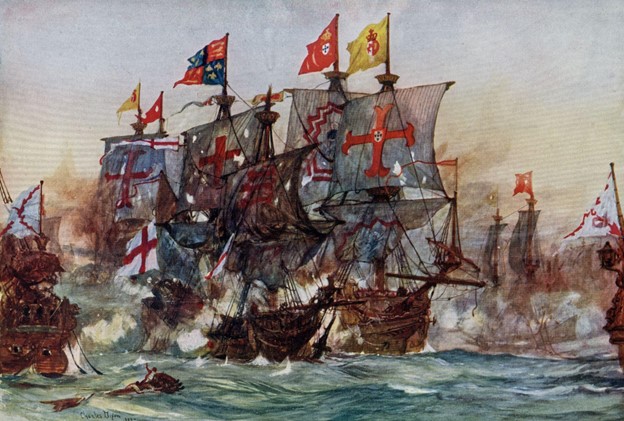
Charles Edward Dixon, "The Revenge during the 1591 Battle of Flores in the Azores," circa 1890-1934. Public Domain.
The Anaemic Lady
It's a bedchamber, by the looks of things. In a wealthy style, with curtains to draw shut and well-patterened cloth. A doctor stands behind her, swirling a medical flask for inspection. Another man stands beside him, her husband perhaps? Note the cat. For the titular lady's part, she is sat before the two as they examine and discuss. She is the brightest of them all. Her sickly pallour floods the space about her, and in that corona she is still, wrapped in pearl and gold.
Even the paltry few stairs that led from the hall to the bedchamber brought her to her tether's end. When she had finally stumbled beyond that last step, the doctor, erroneously thinking himself helpful, brought her to sit in a chair beside the nightstand. It was obvious he did not understand the Heraculean will she must summon to simply stand back up, nor the whirling vertigo that struck her by surprise when she tried. She would have preferred the bed.
There's a door up the stairs to the left of her. The hallway beyond is well-decorated, with an elaborate pattern on the walls and a gilt-framed painting atop the fireplace. There's a pot tucked into a stool under her foot. Within it, there seem to be hot coals to warm her weary foot. Perhaps that warmth has drawn the cat close. But perhaps, with a mouse trapped between its paws, it means to give her a gift. Maybe, with its superior eyesight, it sees through that pale glow to the shadows just beneath her eyes.
She saw the little one crawling out from under the elaborate table-skirt, an unfortunate mouse in its mouth. It dropped it into its paws and looked up at her with expectant, gleaming eyes. The cat had done its job dutifully as a mouser for some time, but skittish as it was, she had never known it to approach her, much less to leave proof of its good work by her footrest. Was her presence so diminished that even that cat felt comfortable to approach? She whispered a commendation to the little helper, and returned to her attempts at repose.
The doctor is focused, his eyes narrowed to a squint. He's taken his gloves off. Apparently he's seen fit to hold the flask with his hands. Is he feeling for temperature? Is the room simply too warm? The other man fixates on the swirling liquid with a face of grim resignation. There is no good news between the pair.
For reasons that are beyond her, the two men are whispering. Do they legitimately think she can't hear them? She can feel every word they say before they say it. What a waste of time, she thinks, to tell each other of her condition. They will sanitize amidst themselves and deliver to her a warm and kind diagnosis that she already knows is wrong. He will clasp a hand over hers as she lay in bed with hardly the strength to think, and he will lie to her about how it's going to be okay. She can feel the fading, the fatigue, the spinning in her head. She doesn't need a doctor to tell her that.
There is a light, shining in from beyond a door or window that we don't have the perspective to see. It creeps along the ground, a soft gradient that mixes evenly with the shadowed room until it hits her. That soft overlay melds away into her own crowned glow. In this view, her light is soft and weak but constant. From here, her pale glow supersedes the light of the Sun. She is sick, perhaps dying, and yet she is as framed as the paintings in the hall. An uncommon word springs to mind: "Crepuscular".
Her eyes felt heavy. The doctor had brought all manner of remedies these past few weeks, and she had undergone all manner of tests. No iron salts or balms had done anything but provide momentary hope. She wished she could sleep, that she could lie down in the bed but it's so far away. He called for the help as the doctor put his gloves back on. The cat slinked back under the table-skirt. With the sound of footsteps down the hall, she begins her attempt to stand. If only he hadn't called for servants. She was already subject enough.
© 2026 Jack Ward
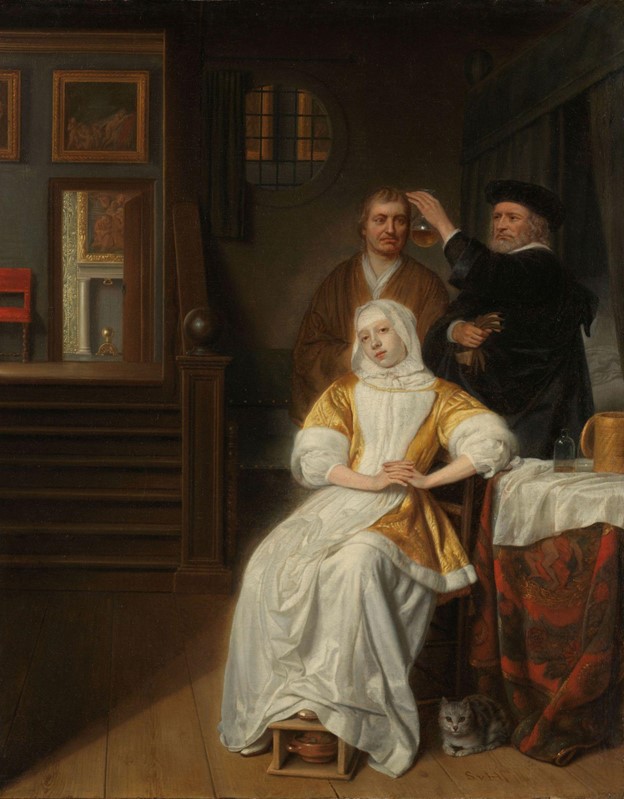
Samuel van Hoogstraten, "The Anaemic Lady," 1660-1678. Oil on canvas. Collection Rijksmuseum, Amsterdam. Public Domain (CC0).